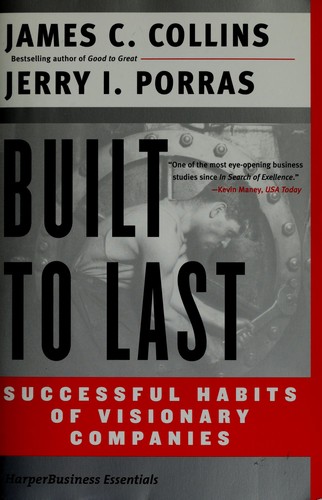
Built to Last
Jim Collins & Jerry Porras
One of my favorite books for generating enthusiasm about building a business, and I still recommend it for that. The core idea is right there in the title: most companies, especially lately, are built NOT to last. Think about the last couple of years: what companies have started that could be the next Sony, the next American Express? Most YC companies aren't even theoretically built to last. They're built to be sold. You can see it in the names. A company named after the atomic problem it's currently solving will never be built to last. Companies built to last follow a mission, not a problem. That framing changed how I think about what I'm building. The caveat: the empirical data part aged badly. The research compared visionary companies against the rest using retrospective interviews and glowing press coverage, which is exactly the halo effect that Rosenzweig takes apart in The Halo Effect, plus the hindsight bias Kahneman documents in Thinking, Fast and Slow. And time ran the experiment for us: Motorola and Sony lost their way, HP and Citicorp stumbled, and the aura of inevitability never matched reality. Read it as a great story that generates conviction, not as science. A tier because the inspiration is real even though the proof never was.